Tuesday, January 3, 2017

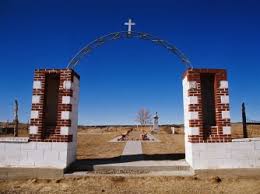
SUNRISE AT WOUNDED KNEE

SUNRISE AT WOUNDED KNEE


Wounded Knee Massacre Memorial Site
December 29, 1890
By all accounts it was a cold morning that greeted the Lakota camp as it arose.  The day before a detachment of about 500 soldiers from the US 7th Cavalry had escorted a band of about 350 Lakota Sioux to an encampment along Wounded Knee Creek on the Pine Ridge Indian Reservation in South Dakota.  Tensions between the two groups ran high that morning as troops attempted to disarm the Lakota before continuing their journey.  No one knows who fired the first shot.  Some say that the shot was fired accidentally. But by the time the ensuing melee ended over 150 Lakota men, women and children, as well as 25 US cavalrymen, lie dead.  Another 51 Sioux and 39 soldiers were wounded; many of whom would succumb to their injuries in the days that followed.


The Lakota Sioux


In late 1890 the Lakota people were dissatisfied.  Already confined to reservations, the US government continued to press the Lakota to give up more of their lands.  The herds of Bison, upon which the Lakota depended for survival, were all but extinct and the US government had failed in its promise to provide food, clothing, and housing to the people as compensation.  The US government also failed to protect reservation lands as miners and settlers continued to disregard reservation borders.  And Indian agents, chartered with advocating for the Lakota, often preyed on the very people they were tasked to represent.


Into this volatile mix came a Paiute prophet named Wovoka. Wovoka had a vision, a vision that the Christian messiah, Jesus Christ, had returned to Earth as a Native American.   In this vision Jesus would raise all of the Native peoples above the Earth, the European invaders would disappear from Native lands, the animals upon which the People depended would return in abundance, and the ghost  of the people’s ancestors would return to Earth and usher in an era of peace and prosperity. Wovoka’s vision spread quickly as the Native people sought a spiritual release from their suffering.  


The European American Settlers


European American settlers along the frontier were frightened by the spread of what they termed “the Messiah Craze” across the plains.  They saw the spread of a common belief system, as evidenced by the performance of the ritual ghost dance, as a unifying agent bringing the disparate tribes together behind a common cause in a prelude to armed revolt.  


In order to prevent the anticipated violence, US government agents decided to detain Native leaders in an attempt to cut off the head of the perceived insurrection.  On December 15, 1890, a contingent of Native American reservation police attempted to arrest Sitting Bull, the renowned Lakota chief, at his home.  During the arrest shots were fired, killing eight Native Americans, including Sitting Bull himself, as well as six tribal policemen.  Fearing reprisal, a band of 350 Sioux, led by a Lakota chief named Black Elk, set out for a safe haven on the Pine Ridge Indian Reservation.  Along the way, they would have their fateful encounter with the US 7th Cavalry.


The US 7th Cavalry


In 1890 the 7th Cavalry was still recovering from its stinging defeat at the hands of the Lakota, Cheyenne, and Arapaho at the Battle of the Little Big Horn just 14 years before.  Many of the soldiers who encountered the small band of Lakota that day on the plains of South Dakota were survivors of that battle.  Led by Col. James W. Forsyth, this same 7th Cavalry intercepted Black Elk’s band and escorted them to a site along Wounded Knee Creek.  Once encamped, Col. Forsyth set up a ring of high-powered, rapid fire weapons around the Lakota camp and prepared to disarm them in advance of escorting them to waiting trains for deportation to places unknown.


The stage was set for disaster.  The Lakota, already angry at what they perceived as another in a series of broken promises by the US government were, once again, facing disarmament and forced relocation.  The 7th Cavalry, urged on by settler’s fears of a resurgent Native people and impending violence, with the memory of Little Big Horn fresh in their minds, was in position to unleash a barrage of death and destruction at the first sign of danger.  


And then, into this volatile mix of anger, fear, mistrust, and resentment, a single shot was fired.


Same Event, Different Perceptions


Few dispute the facts surrounding the incident at Wounded Knee. Reacting to shots fired the US 7th Cavalry opened fire on a group of 350 Lakota men, women, and children; killing over 150.  In the melee the Lakota also killed some 29 US Cavalry troops before being subdued by superior numbers and firepower.  But the meaning of the event to the two communities was radically different.  For the most part the European American community was not concerned by the incident; seeing it as another in a series of necessary encounters to secure the Western frontier. Some asserted that the incident was further proof of the legitimacy of the US policy towards Native peoples, as evidenced by an editorial which appeared in the Aberdeen Saturday Pioneer on January 3, 1891:


The Pioneer has before declared that our only safety depends upon the total extermination of the Indians. Having wronged them for centuries, we had better, in order to protect our civilization, follow it up by one more wrong and wipe these untamed and untamable creatures from the face of the earth. In this lies future safety for our settlers and the soldiers who are under incompetent commands. Otherwise, we may expect future years to be as full of trouble with the redskins as those have been in the past.


The meaning of the incident to the Native people involved was radically different, as evidenced by this statement made by Black Elk, the leader of the Lakota band, in the waning days of his life:


Black Elk
"I did not know then how much was ended. When I look back now from this high hill of my old age, I can still see the butchered women and children lying heaped and scattered all along the crooked gulch as plain as when I saw them with eyes young. And I can see that something else died there in the bloody mud, and was buried in the blizzard. A people's dream died there. It was a beautiful dream . . . . the nation's hoop is broken and scattered. There is no center any longer, and the sacred tree is dead."


Monday, January 2, 2017

MAYFLIES


The days were long and unusually warm for that time and place, late June in the Boundary Waters wilderness area in northern Minnesota, where a group of six Boy Scouts and their sponsors canoed for ten long days and steamy nights. On the third day of the trip we paddled into camp for what we thought would be a routine night of fishing and tall tales around the fire.  What we did not know was that we were about to experience a miracle of nature, one played out in one night increments across the wild areas of the far north each year. For that night the Mayflies had decided that the time was right to perform their one-night symphony of life, procreation, and death.


It began as the last rays of the dying sun filtered through the trees surrounding us. At first the forest seemed to come alive, with every leaf, branch, and tree vibrating with a subdued buzz. Within minutes that buzz rose in a crescendo to a deafening roar that exploded into the sky in a thunderstorm of light, sound, and motion. A vortex of Mayflies thundered around us while light from the setting sun crackled from millions of beating wings.  Curtain after curtain of insects lashed against us, inundating us in a endless torrent of life.


At first the whirling of the insects seemed arbitrary. But as our shock diminished and the awe of the experience took hold, we began to see patterns within the ebb and flow – swirls and spirals that were manifest only when we freed our minds to look deeper; beyond the superficial sights and sounds surrounding us. The movement of any single Mayfly seemed random, but each insect danced its part in a grand ballet, fulfilling a collective purpose that has driven Mayflies since time immemorial.  


By first light of morning they were gone; the only evidence of their existence being spent carcasses scattered across the ground and waters around us. A miracle of life had played out around our little group that night, and those of us who experienced it were forever changed. For we were witness to a grand exhibition of life at its core; and, for the briefest and rarest of moments, we were infused with the power that underlies the universe and felt its energy flowing through us.

Sunday, January 1, 2017

REQUIEM FOR A RIVER BOTTOM


Dawn is approaching rapidly on this cold morning in May.  I'm standing outside my truck on a lonely gravel road in Fannin County awaiting the rising sun.  Ragged clouds flee south ahead of a late cold front.  Rustling leaves and moaning branches break the morning stillness.  As the sun clears the horizon, thirty-four volunteers scatter across this rural county in Northeast Texas as part of the annual Bobwhite quail census.  Each of us drives a prescribed route, stops at designated points along the way, and counts the number and location of any distinctive “bob white” bird calls we hear.  My route takes me through the heart of the Bois D’Arc Bottoms, a large tract of hardwood bottomland that follows Bois D’Arc Creek on its winding path east and north to the Red River. 

Bobwhite quail were abundant in Fannin county until 30 years ago when the population began a steep decline.  Most days you will find old timers nursing cups of coffee at the River Bend Café, remembering the simpler times and places of their youth.  Often the conversation turns to the reasons for the quail decline.  The general consensus amongst the men is that the decline is due to the imported red fire ant or urban expansion and subsequent habitat fragmentation.  They surmise that fire ants prey on quail chicks, and they know quail need large tracts of unbroken land to establish a viable community.  In truth there is no single reason.  Local conservation officials’ last hope is that ongoing census efforts will shed some light on the decline.  Despite the unfavorable weather, all 34 of us set out with high hopes of logging quail.  
 
Thirty minutes later my truck tires crunch to a stop at a survey point where Bois D’Arc Creek crosses a major highway.  The creek begins its life in eastern Grayson County in Northeast Texas near the town of Whitewright.   Then it winds its way along a 68-mile muddy ribbon between the low rolling hills of Fannin County, draining some 425 square miles of North Texas, before entering the Red River.  To some observers, Bois D’Arc Creek is just a muddy ditch, but others understand that it is noteworthy in many ways.  

Bois d’Arc Creek is one of a handful of rivers and creeks that are unique in Texas because they do not flow directly to the Gulf of Mexico.  Rather, the murky waters of Bois d’Arc Creek merge with the Red River and then the Mississippi River before spilling into the Gulf south of New Orleans. There black Texas mud enriches the vast Mississippi River Delta. Even more significantly, the hardwood forest of the Bois D’Arc Bottoms represents an ecosystem that is disappearing rapidly in the face of an ever-expanding urban population placing new demands on land and water resources throughout the region. 

The Bottoms are home to a wide variety of wildlife species, both common and rare.  Eagles, black buzzards, and turkey vultures soar high above the creek looking for their next meal.  Whitetail deer, while less common in Fannin County, frequent the Bottoms where towering oaks and pecans rain manna from above and provide safety and shelter.  Beaver, muskrat, and the occasional otter dance along the stream bank.  And paddlefish, so named for their unique ability to negotiate the low water levels of summer, splash in the shallow pools.  To the surprise of all, black bears have reappeared along the creek; having wandered into the area from the dense forests and weathered remains of the Ouachita Mountains of southeastern Oklahoma.  
 
Along  my way to my next stop I crest a small hill, slide down a muddy two-track path, and find myself in the heart of the Bottoms.  Here towering trees shelter me from the cold wind whistling above.   Through the trees I can see the remains of an abandoned farm: grey weathered wood of a collapsed barn, scattered bones of farm equipment stained rust-red by rain and wind, and pastures dotted with Cedar Elms, Cedars, and Bois D’Arc trees as they revert slowly to woodlands.  

The Bottoms have been home to humans for millennia, drawn by abundant wildlife, year-round water, and rich soils.  Historians and archeologists place the native Caddo people in the area as early as 4,000 years ago.  While Bois D’Arc Creek was at the far western edge of their homeland, the Caddo frequently traversed the region seeking the sea of buffalo found on the Blackland and Grand prairies.   The Caddo were a farming people and took advantage of the many natural meadows in the fertile bottoms to grow their crops.  Archeologists believe when natural openings were not available the Caddo created their own by clearing trees with stone axes and the judicious use of fire.  To this day burial mounds dot the landscape near the Red River, and hikers along the creek often find small remains of the Caddo culture, such as stone arrowheads and the rare pottery shard.  

The first permanent European settlers came to the Bottoms in 1836, when Daniel Rowlett and six other families arrived on the banks of Bois D’ Arc Creek.  Legend has it that pioneer Davy Crockett stopped near the present day town of Honey Grove on his way to San Antonio in the winter of 1836.  Some even claim he gave the town its name.   Before departing he is said to have written his wife in Tennessee about the richness of “Bodark Bayou” and his hopes of returning with his family one day.  But first, Crockett and a small group of “Texian” volunteers vowed to face down the Mexican army at Mission San Antonio de Valero, otherwise known as the Alamo.  History confirms that Davy Crockett would never return to Bois D’Arc Creek, and his name was enshrined forever in Texas lore.  To this day, the town of Honey Grove celebrates “Davy Crockett Day” each October.

Throughout history the Bottoms have provided rich land for farming.  The new settlers picked up where the Caddo left off; first farming the patches of open meadow that the Caddo had maintained for centuries, then expanding their farms until virtually all the native prairie and woods was converted to human purpose.  Early in the 20th century the main crops were cotton and corn.  Now the Bottoms primarily support small ranching operations.   In retrospect, Fannin County peaked in the first two decades of the 20th century.  Both cotton and corn production reached its highest level at that time as did the number of farms in operation. The population of Fannin County peaked in 1900 and has decreased steadily since.  Still, many descendants of the original settlers continue to farm the Bottoms.  Harold Witcher’s people came to the Bottoms from Virginia and began farming in 1859.  Members of his family fought in the Civil War and are buried in a small cemetery in the Bottoms.  Today Harold runs beef cattle on the rich pastures along the creek. Joe Carpenter is a relative newcomer to the Bottoms, having raised dairy cattle there for some 32 years.   Stuart Richardson is a third generation rancher who grew up along the Creek and raised his two children in its rich lands.  Stuart’s love of the land and sense of responsibility for its care runs deep.  He had hoped his son would carry on the ranching tradition and raise his family on the family land in the Bottoms. But plans for the Lower Bois D’Arc Reservoir have put an end to his hopes for his son, and the arc of his family’s story will change forever.

My last stop of the day finds me near Lake Crockett, one of a chain of reservoirs along Bois D’Arc Creek. The Corps of Engineers built three small impoundments, lakes Crockett, Coffee Mill, and Bonham, in the 1930s for flood control, drinking water, and recreation. Each of the lakes is nestled in the hardwood forest of the Bottoms and frequented by wildlife.  Thousands of waterfowl commonly cluster in and around the lakes during the fall migration season. The recreation areas around the reservoirs were built by the Civilian Conservation Corps (CCC) and are fine examples of CCC architecture.  Nonetheless these three lakes will be overcome when a new reservoir fills, and the unique CCC architecture and intimacy of the existing lakes will be lost forever.

Around mid-day I complete my portion of the quail survey and head back to town to file my report.  I did not hear any quail today.  I believe, perhaps naively, that my failure is the result of poor weather conditions and not evidence of further quail decline.  While I did not log any quail, I took the opportunity to take one last look at a unique ecosystem that soon will be lost forever.  I often think of the Bottoms as the land that time forgot, replete with rolling hills, grazing cattle, neat farms, and forested creeks.   Soon the Bottoms will exist only in memory.  The 16,000 acre Lower Bois D’Arc reservoir, scheduled to begin construction in 2018, will cover the entire area to a depth of some 45 feet so that the thirsty Dallas Metroplex can continue its relentless expansion.  Farms, ranches, homesteads, and cemeteries-- those places that bind people to the land--will disappear forever.  Boosters claim that the new reservoir will bring financial opportunity to an economically disadvantaged area in the form of jobs, recreation venues, and expanded business.  Those who accept reality acknowledge it will also bring urban development, boats and jet skis, crowds, traffic, and noise.  Time is about to catch up with the Bois D’Arc Bottoms.  And those things that make the Bottoms unique will be washed away.  And all of our lives will be diminished because of it.

Friday, December 30, 2016

DOES ANYBODY REALLY KNOW WHAT TIME IT IS?


I’ve been pondering the nature of time since reading “Slaughterhouse Five” by Kurt Vonnegut in high school. In case you haven’t read the book, it involves a protagonist, Billy Pilgrim, who has become “unstuck in time”, meaning that he bounces between various times in his life and experiences events in real time. While this premise is an interesting science fiction twist in itself Vonnegut uses it to make a statement about the bombing of Dresden Germany during WWII.  More about this later.

Walking around my house the other day I noticed we have clocks everywhere; on the walls, on night stands, on my microwave and oven, on my arm, and in my pocket of all places. The other thing I noticed is that none of them had the same time. I was about to reset all my clocks when I remembered my sainted grandmother Alice. Alice was born in Cornwall at the turn of the 20th century into a world much different than ours. Hers was a world without electrification, where horses were the primary mode of transportation, and people died routinely of diseases we've put behind us. She lived through two world wars and saw humans walk on the moon. Yet through it all her concept of time never changed. To Alice there were only four times, on the hour, quarter past the hour, half past the hour, and quarter to the hour. That was all the accuracy she needed to order her day. There is a simplicity to this that is strangely compelling. Time is such an artificial construct and our communal illusion of accuracy fostered by digital timepieces makes it even more so.  

The discrepancies between timepieces made me think of the term “precision”.  Precision is a mathematical term that speaks to the accuracy of performing a mathematical function on numbers that have a different number of significant digits. The rule is that the result of any mathematical function performed on any series of numbers cannot be more precise than the number with the least significant digits following a decimal point.  For example, let’s multiply 452 times 5.7563. If you are using a calculator that will display fractions to the 10,000th place you will get the following result:

452 X 5.7563 = 2601.8476

In mathematics this is known as false precision. Since the number 452 does not contain any digits to the right of the decimal place the result of the multiplication cannot have a higher level of accuracy than the number 452.  Therefore, the correct answer to the multiplication problem is:

452 X 5.7563 = 2601.8476 or 2601. 

Note also that you cannot round the .8 up to make the answer 2602 either since that would make the .8 a significant digit in this case.

What does this say about how we measure and perceive time? Can I really say that at this instant it is 4:27:18 in the afternoon? Do the tools I have to measure time perform at that level of accuracy or is this another example of “false precision”? Perhaps more importantly, do I really need to know the time to the hundredth of a second, or the tenth of a second, or the second, or the minute? Or, as I suspect, do I need no more accuracy than that of Alice to give structure to my day?

Now back to Slaughterhouse Five. Slaughterhouse Five led me to question how we experience time. We perceive time as a continuous flow from the past, to the present, to the future. Proof of the linearity of time generally centers around entropy. Since entropy involves the linear decomposition of the universe from a higher energy state to a lower energy state scientists use entropy as an analog for the linearity and directionality of time. But what if, as proposed in Slaughterhouse Five, time isn’t linear? What if our perception of linearity is nothing more than an artificial construct of our human minds?

Silly you say? For evidence of the non-linearity of time we need look no further that Einstein. Einstein’s work demonstrates that time is relative and can be affected by factors such as velocity and mass. How I experience time is different from how you experience time if, for example, if I am traveling at extreme speed relative to you or if I am in close proximity to a large mass and you are not. Elements of the film “Interstellar” depend on this fact. This holds true for us in our physical environment as well. For example, if you and I are walking down the sidewalk at the same velocity we experience time in the same way. 


If, however, one of us diverges from this path and walks in a different direction at the same velocity, how we experience time is now different. 


Of course, at walking speed this difference is too little for us to notice. So while it may not be possible for use to become “unstuck in time” as was Billy Pilgrim, it certainly is possible for us to experience the passage of time differently.

But what about space-time? You and I occupy the same physical space as countless other entities but at a different point in time. Is it possible to be aware of the entities that occupied the same space as us in the past? I had a “time traveler” moment while on a trip to Rome a few years ago. I was standing in the center of the old Roman Forum and, for a brief moment, I thought I could feel the presence of the thousands of people that occupied this space before me. I sensed the presence to Roman legions parading past the cheering throngs along the Appian Way. I felt the presence of emperors, senators, citizens and slaves going about their daily business around me. Unfortunately, the connection did not last and I was brought back to our space-time by our guide for the day. 

So time remains an enigmatic mystery to me. I find that I continue to ruminate on the nature of time when I find myself gazing at the stars.  And since that day in Rome I’ve tried to tune into the lives of those that went before me, and in doing so break the bonds of space and time.